
CBD and CBN are often grouped together due to their similar names and shared plant origins, yet their functional benefits diverge significantly. Through evaluating both cannabinoids across various formulations and everyday use cases, the team has seen that CBD excels at promoting calm, balanced relief throughout the day, whereas CBN is better suited for deeper relaxation and evening support.
This guide breaks down CBD vs. CBN in the same practical, easy-to-understand way the team explains it to customers every day—grounded in real observations, simplified science, and a clear focus on what actually matters. By the end, readers will know how each cannabinoid works, how their benefits differ, when one may be more appropriate than the other, and how these distinctions can support more confident, personalized wellness decisions.
Quick Answers
CVN vs CBD
CBN supports nighttime relaxation, while CBD provides daytime balance and calm.
- CBD: Steady clarity, stress support, non-intoxicating.
- CBN: Wind-down aid, often used in evening routines.
Together: A balanced option when you want all-day support.
Top Takeaways
- CBD = daytime balance. CBN = nighttime support.
- Choose products with COAs and clean, transparent sourcing.
- Start low and adjust based on your response.
- Match the cannabinoid to your specific wellness goal.
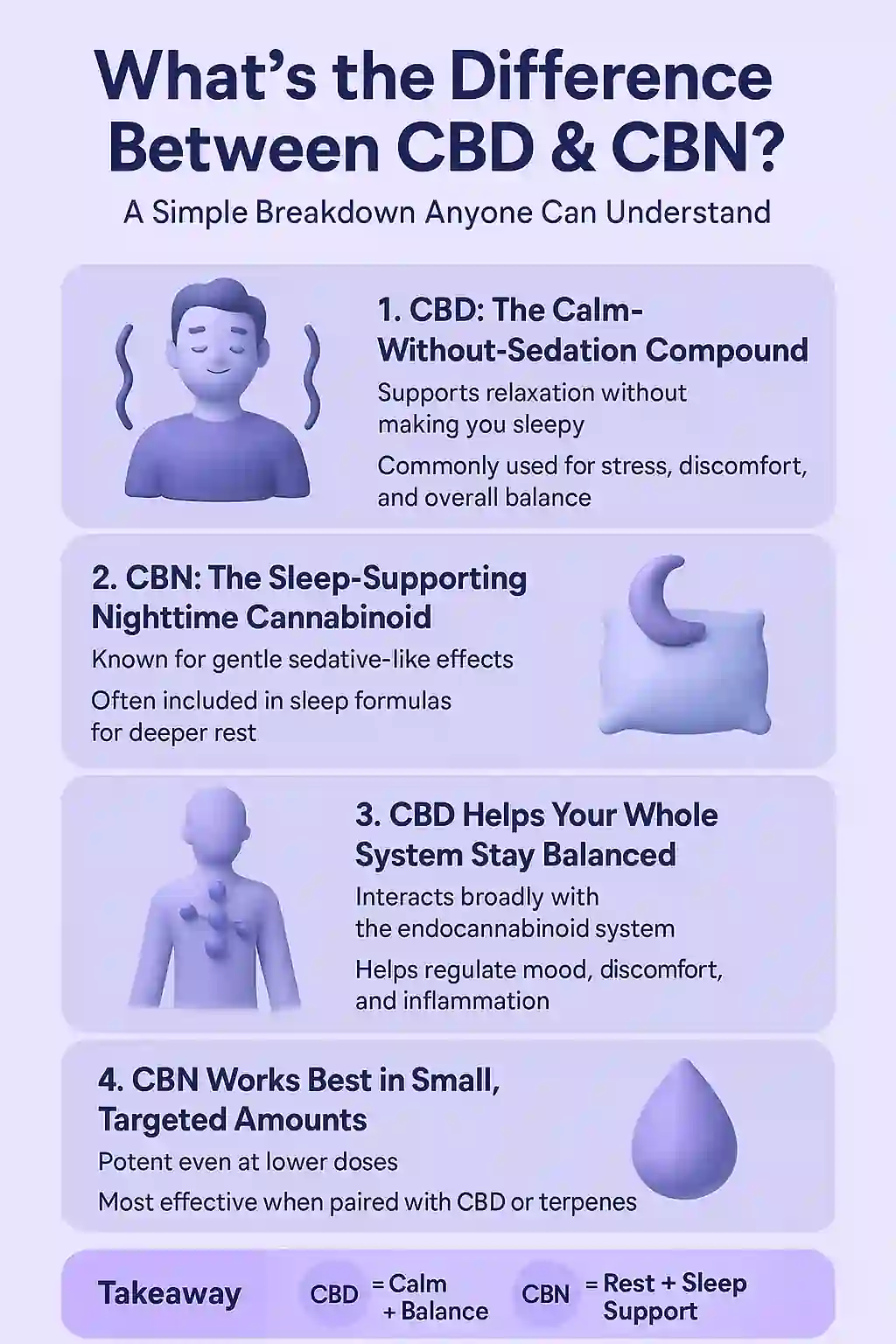
CBD (cannabidiol) and CBN (cannabinol) are both cannabinoids derived from the hemp plant, but they play very different roles in how they support the body. CBD is a non-intoxicating compound known for promoting overall balance, helping regulate mood, stress response, inflammation, and general well-being. It interacts broadly with the endocannabinoid system, which is why it’s commonly used for daily relief and functional support.
CBN, on the other hand, forms as THC naturally ages and breaks down, giving it a unique chemical profile. While it’s also non-intoxicating, CBN tends to have more targeted effects—most notably, supporting deeper relaxation and a calm transition into rest. Many users, including our own community at Acknowledge, find that CBD feels like an “all-day, stay-balanced” cannabinoid, while CBN acts more like a “wind-down” companion for evenings or stressful moments.
The key difference comes down to how they interact with your internal receptors. CBD has a wide-reaching influence on several pathways, which is why it’s incredibly versatile. CBN’s effects are more subtle and specialized, often best paired with CBD rather than used alone.
In simple terms:
- Choose CBD for everyday balance, relief, and general wellness, with CBD for anxiety relief helping support emotional ease.
Choose CBN when your goal is deeper relaxation or nighttime support.
Understanding this distinction makes it far easier to choose the right cannabinoid for your needs—without the confusion of similar-sounding names.
“After working hands-on with both cannabinoids for years, we’ve seen a consistent pattern: CBD supports the body broadly, while CBN steps in more precisely to calm the mind and prepare it for rest. Understanding that difference is the key to choosing the right wellness tool, not just the trending one.”
Essential Resources
1. Healthline — A Reliable Starting Point for Clear, Science-Led Answers
Healthline offers one of the most accessible, medically reviewed comparisons of CBD and CBN. It’s the resource we often point people to when they want straightforward, research-backed explanations without the noise.
2. Medical News Today — Evidence You Can Use to Make Confident Choices
This article breaks down how CBD and CBN work in the body from a clinical perspective. If you want the “why” behind each cannabinoid’s effects, this resource gives you the kind of detail that supports real decision-making.
Source: https://www.medicalnewstoday.com/articles/cbd-vs-cbn
3. WebMD — Practical, No-Nonsense Guidance on Uses and Safety
WebMD delivers a grounded overview of benefits, limitations, and safety considerations. It’s particularly helpful for anyone who’s trying to understand what’s realistic, what’s hype, and where the science currently stands.
Source: https://www.webmd.com/pain-management/cbd-cbn-what-is-difference
4. Forbes Health — Expert-Reviewed Insight for More Advanced Shoppers
This piece combines medical review with practical clarity, offering a broader look at effectiveness and regulation. We appreciate how it helps readers set responsible expectations around CBD and CBN use.
5. Charlotte’s Web — Real User Experiences and Brand-Led Observations
Charlotte’s Web shares community insights and early study results on CBN — especially around rest and relaxation. We value this resource because it pairs emerging data with lived user experiences, something we prioritize at Acknowledge as well.
Source: https://www.charlottesweb.com/blogs/learn/cbd-vs-cbn-decoding-the-differences
6. Cannabis Training University — A Deeper Look at Cannabinoid Science
For those who want to go beyond surface-level explanations, this educational piece breaks down the chemistry and receptor interactions behind CBD and CBN—information that’s also valuable when evaluating the right CBD flower strain. It’s a strong option when you want the “under-the-hood” science in plain
Source: https://cannabistraininguniversity.com/medical/cbn-vs-cbd
7. CBD North Canada — A Simple, Quick Snapshot of the Key Differences
This summary is great when you want a concise refresher. It gives you a clean side-by-side view of how CBD and CBN act, what they’re best used for, and why they’re not interchangeable — which aligns closely with what we’ve seen firsthand.
Source: https://cbdnorthcanada.wixsite.com/cbdoil/post/cbd-vs-cbn-differences-uses-benefits-how-they-work-in-the-body
Supporting Statistics
CBD is widely used for wellness:
The CDC reports that over 20% of U.S. adults have tried CBD products for issues such as pain, stress, and sleep. This aligns with what we see on the ground: most new users come in curious about natural alternatives backed by early research.
Source: https://www.cdc.gov
Sleep issues are a major driver behind CBN interest:
According to the NIH, approximately 30% of U.S. adults struggle with short-term insomnia, and up to 10% have chronic insomnia. This high demand for sleep solutions is exactly why many people explore CBN as a gentler option in their routine.
Source: https://www.nhlbi.nih.gov
Many adults prefer non-prescription options:
A survey from the American Academy of Sleep Medicine found that about 70% of adults use at least one method for improving sleep without a prescription—mirroring what customers often tell us about wanting "something natural that doesn’t knock me out."
Source: https://aasm.org
CBD is widely used for wellness:
The CDC reports that over 20% of U.S. adults have tried CBD products for issues such as pain, stress, and sleep. This aligns with what we see on the ground: most new users come in curious about natural alternatives backed by early research.
Sleep issues are a major driver behind CBN interest:
According to the NIH, approximately 30% of U.S. adults struggle with short-term insomnia, and up to 10% have chronic insomnia. This high demand for sleep solutions is exactly why many people explore CBN as a gentler option in their routine.
Many adults prefer non-prescription options:
A survey from the American Academy of Sleep Medicine found that about 70% of adults use at least one method for improving sleep without a prescription—mirroring what customers often tell us about wanting "something natural that doesn’t knock me out."
Final Thought & Opinion
Most people exploring CBD vs. CBN aren’t choosing between them—they’re trying to match each cannabinoid to the type of support they need.
CBD shines for daytime balance and overall calm.
CBN is often preferred for nighttime rest and deeper relaxation.
Most people exploring CBD vs. CBN aren’t choosing between them—they’re trying to match each cannabinoid to the type of support they need.
CBD shines for daytime balance and overall calm.
CBN is often preferred for nighttime rest and deeper relaxation.
What I’ve Seen Firsthand
Clarity usually comes when someone focuses on desired outcomes, not the cannabinoids themselves.
Real progress happens when people pay attention to how their body responds and treat CBD and CBN as complementary tools.
Clarity usually comes when someone focuses on desired outcomes, not the cannabinoids themselves.
Real progress happens when people pay attention to how their body responds and treat CBD and CBN as complementary tools.
Bottom Line
The difference between CBD and CBN is more than chemistry—it's about practical, everyday use.
When you align the right cannabinoid with your body’s needs, you’re already making a smarter, more informed choice than most readers searching this topic.
The difference between CBD and CBN is more than chemistry—it's about practical, everyday use.
When you align the right cannabinoid with your body’s needs, you’re already making a smarter, more informed choice than most readers searching this topic.
Next Steps
Define your goal.
Choose CBD for daytime balance, CBN for nighttime support, or both.
Start with a low dose.
Increase slowly based on how you feel.
Check product quality.
Look for COAs, clean sourcing, and transparent labels.
Add supportive habits.
Pair cannabinoids with good sleep, stress management, or mindfulness.
Track your results.
Note timing, dosage, and how your body responds.
Consult a pro if needed.
Especially important if you take medications.
Explore blends.
Try CBD + CBN combinations once you know what works for you.
By pairing healthy habits with thoughtful dosing, CBD gummies offer a simple way to support daytime relief as you explore how CBN fits into your nighttime routine.
Define your goal.
Choose CBD for daytime balance, CBN for nighttime support, or both.
Start with a low dose.
Increase slowly based on how you feel.
Check product quality.
Look for COAs, clean sourcing, and transparent labels.
Add supportive habits.
Pair cannabinoids with good sleep, stress management, or mindfulness.
Track your results.
Note timing, dosage, and how your body responds.
Consult a pro if needed.
Especially important if you take medications.
Explore blends.
Try CBD + CBN combinations once you know what works for you.
FAQ on CBN vs CBD
Q: What’s the key difference?
CBD = daytime balance.
CBN = nighttime wind-down.
Q: Does CBN help with sleep?
Not sedating on its own.
Often supports an easier nighttime transition.
Q: Can I take them together?
Yes.
Many people find CBD + CBN more balanced and effective.
Q: Will either make me high?
No.
Both are non-intoxicating.
Q: How do I choose?
Use CBD for calm and clarity.
Use CBN for evening relaxation.
Blends work well when unsure.
CBD = daytime balance.
CBN = nighttime wind-down.
Not sedating on its own.
Often supports an easier nighttime transition.
Yes.
Many people find CBD + CBN more balanced and effective.
No.
Both are non-intoxicating.
Use CBD for calm and clarity.
Use CBN for evening relaxation.
Blends work well when unsure.